Systems Thinking
See the feedback loops and relationships connecting people, strategy, culture, and technology.
Learn moreInnovation ecosystems
Today’s business challenges are interconnected. Linear, one-problem-at-a-time solutions cannot resolve them. Sophia Network helps leaders work with culture, strategy, technology, and people as one living innovation ecosystem.
Explore the framework
Culture, Structure, and Implementation, with Leadership as the natural outcome.
Nine converging disruptive forces
These forces do not operate in parallel. They operate systemically, force amplifying force. Solving one in isolation produces unintended consequences that multiply through the interconnections.
Constantly shifting priorities and unclear objectives create decision paralysis at every level. Strategic plans that once held for eighteen months are rewritten quarterly, and still can't keep pace with the change.
An 85-million-worker shortage, not of workers generally, but of cross-functional expertise our educational systems don't produce. AI plus deep industry knowledge, medicine plus machine learning: combinations that exist in hundreds of professionals, not thousands. You cannot hire your way out of a pipeline that doesn't exist.
Seventy percent of preventable departures trace to management experiences. Today's workforce treats jobs like rental cars, valuable for the journey, never owned.
Trillions spent on innovation, funding safe renovations instead of breakthroughs, leaving a company vulnerable the moment its rival takes the risks it will not.
Three-year strategic plans now become obsolete in three months. The instinctive response, more research, more scenarios, more analysis, buys a false sense of control while decisions wait on the uncertainty no model can eliminate. Plans go out of date while they are still being written.
Conflicting policies across administrations make long-term planning nearly impossible. A company prepares for one environment and operates in another within weeks or months.
High-trust organizations report 74 percent less stress, 106 percent more energy, 50 percent higher productivity, and 76 percent more engagement than low-trust ones, and when trust breaks down, performance collapses regardless of individual talent or pay. Meanwhile, middle managers spend 41 percent of their time on tasks that add no value, burning out between executive demands for innovation and frontline resistance to change.
The soon-to-be-largest generation in the workforce is refusing to join organizations where they cannot express their talent at work, that fear necessary failures and that are focused on profit without purpose.
AI, quantum computing, digital twins, and the Internet of Things demand seamless cross-functional integration to deliver their full value, integration that departmental silos make technically impossible. Organizations spend billions on the tools while leaving intact the very structures that defeat them: sophisticated technology in the hands of nineteenth-century organizational structures. The technology is not the problem. The structure is.
The nine disruptive forces do not operate in parallel. They operate systemically, in interconnected loops, where the unintended consequences of one cascade through all the others.
Cultural breakdowns reinforce talent scarcity. Talent scarcity creates innovation paralysis, which deepens generational divides, which compounds vulnerability to the Quantum-AI Convergence, and the cycle circles back to accelerate cultural breakdown. (Figure 1-1 in the book.)
The Great Talent Drought, the Generation Z Revolution, and the Policy Whiplash Crisis all flow through the same loop. A linear attempt to hire more fails because Generation Z is not negotiating a wage transaction. They are evaluating whether a company's culture deserves them. Policy whiplash around immigration and remote work further destabilizes the talent pool. The cultural reinforcing loop defeats the resource-scarcity balancing loop almost every time.
The Quantum-AI Convergence and the Planning Paralysis Crisis freeze capital at the exact moment experimentation is most needed. The speed of AI renders long-range plans obsolete, raising perceived risk, which starves the early-stage experiments that are the most reliable way to learn in a complex system.
Disengagement and stalled innovation are cause and effect. Knowledge spillovers rely on dense, serendipitous human connection, and when disengagement rises, those collisions stop.
Underneath all of it, the Cultural Collapse is not one force among nine. It is the medium through which all the others interact.

Coming October 22, 2026
A Dynamic Blueprint for Organizational Success and Engagement
Foreword by Peter Senge, author of The Fifth Discipline. “I highly recommend you read this book”, Tom Peters.
John Murray Press, a division of Hachette
What makes our methodology different?
Seventy percent of all organizational change initiatives fail because of employee resistance, and resistance takes root where psychological safety is missing. Psychological safety is created through deep listening: when people are fully heard, they release the upset that gets expressed as resistance and become genuine participants in change rather than passive recipients of it.
The methodology unites systems thinking, psychological safety created through deep listening, and an exponential, iterative process. It is a systemic methodology for all projects, not a checklist of the nine disruptive forces.
Our framework brings the human and operational conditions for innovation into one connected practice.
Explore the frameworkSee the feedback loops and relationships connecting people, strategy, culture, and technology.
Learn moreCreate the safety people need to contribute openly through deep listening.
Learn morePrototype rapidly and learn with continuous stakeholder feedback.
Learn moreSeventy percent of all organizational change initiatives fail because of employee resistance, and resistance takes root where psychological safety is missing.
Psychological safety is created through deep listening. Deep listening is not active listening or empathetic nodding. It is the disciplined practice of listening from a clean canvas: letting your internal judgments and evaluations go so you can remain fully present with another person.
When people are fully heard, they release the upset that gets expressed as resistance and become genuine participants in transformation rather than passive recipients of it. Deep listening is the antidote to resistance.
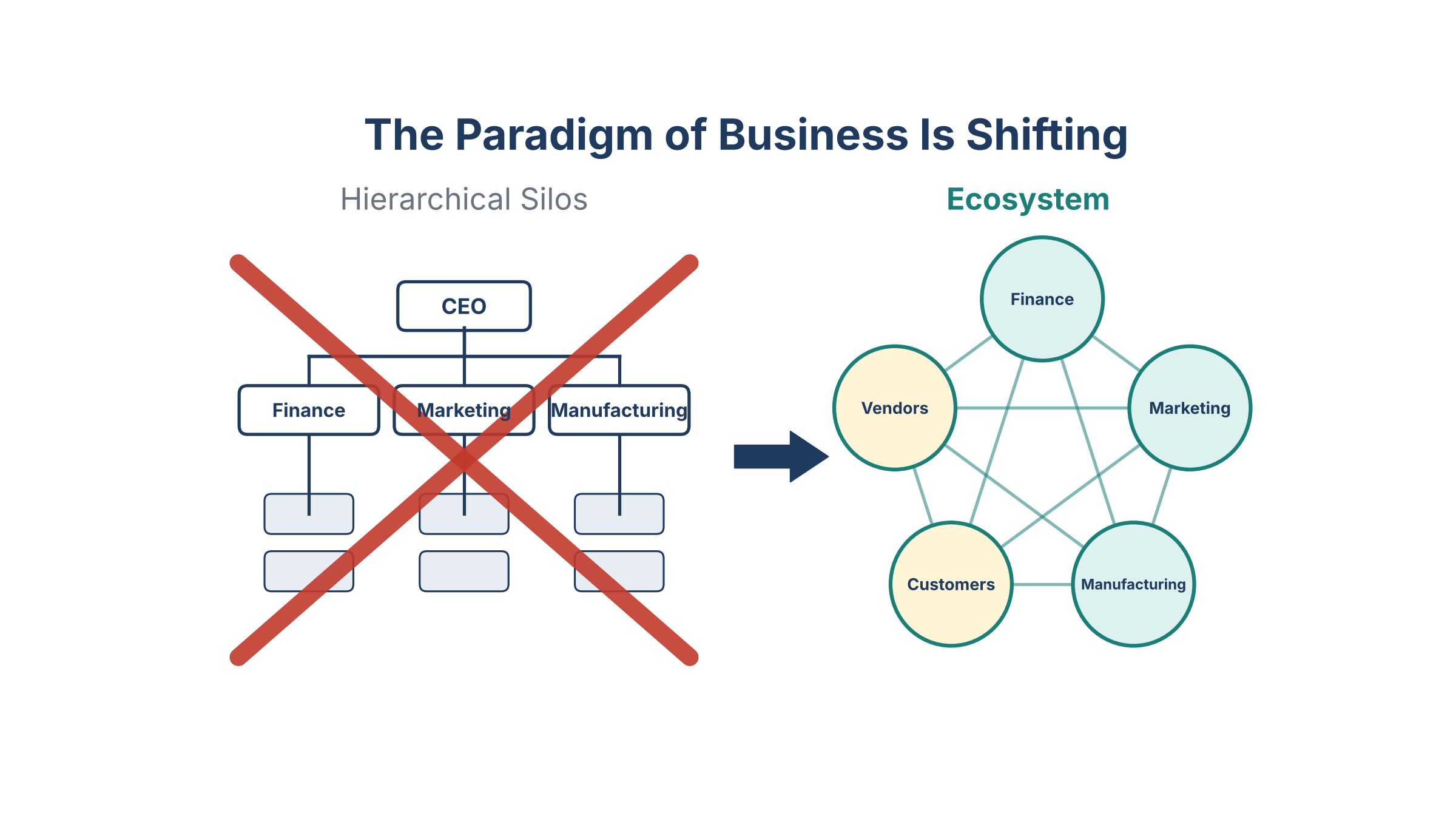
Isolated silos
Separate decisions. Unseen consequences.
An innovation ecosystem
Shared understanding. Connected action.
Aligned teams prototype projects and strategies, gather stakeholder feedback, and iterate again and again. This process shortens cycle time.
An interconnected ecosystem
Culture, Structure, and Implementation are not three separate steps or independent parts. They form an interconnected ecosystem, each shaping the others. Natural leadership emerges from engaging in that system, rather than being imposed on it.
Meet Sophia NetworkCreate a shared identity, aligned leadership, and the cultural conditions for a new organisation to move together.
02Turn urgent strategic work into cross-functional action with learning built into the work itself.
03Build the psychological safety, shared purpose, and operating habits that facilitate consequential work.
04Help executive teams listen across differences, make clearer decisions, and lead change as one system.
05We provide a roadmap for building your Innovation Ecosystem, so your organization does not need consulting after nine months of training and implementation.
I never expected there would be such a cultural revolution in just 6 months. I was planning on leaving the company. Really glad I stayed.
VP Operations, Healthcare Insurance Company
A free virtual gathering
Join Ilene Fischer for the launch of Innovation Ecosystems by Ilene Fischer.
Evidence in the work
Explore four stories of leaders creating shared capacity across acquisition, restructuring, and mission-critical work.
Read the case studiesA conversation, not a sales pitch